Do you need a seal test stand?Enter your postcode and arrange a consultation about your test machine directly.
We would also be happy to visit you in person.
Postcode search
This is why customers choose Hänchen test machines:
  • In-house experience in testing seals
  • Comprehensive consultation
  • Individual concept according to customer requirements
  • Implementation of only required functions saves costs
  • Many decades of know-how in hydraulics
  • Test stand construction including CE
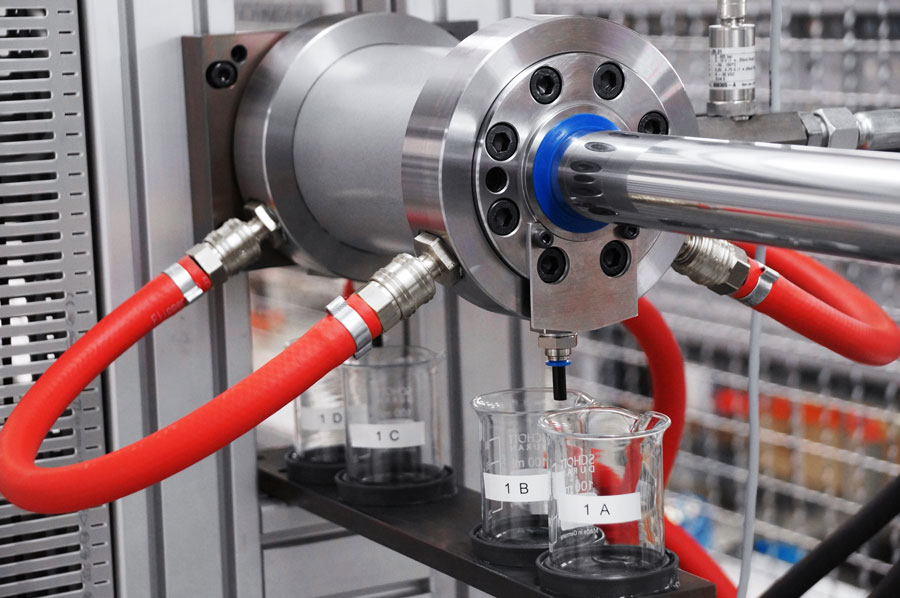
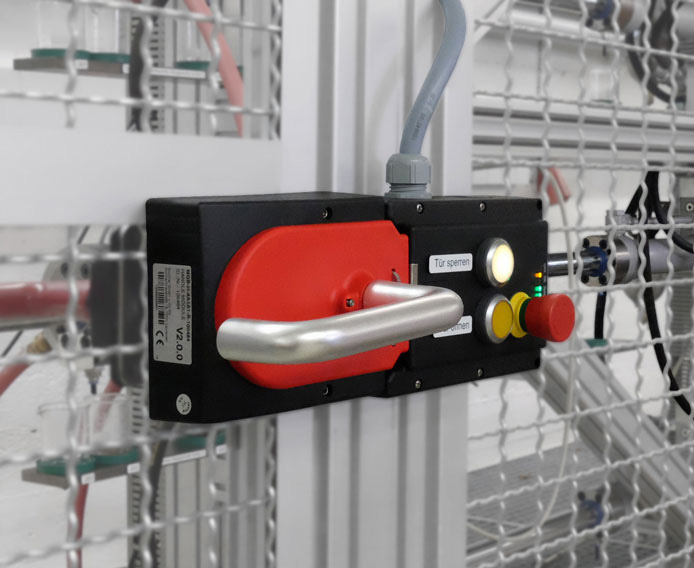
Image 1 Protective fence as a technical safety measure
Image 2 Individual seal testing, including the test sequence of seal combinations at Hänchen, with a running performance of 300 km in 24-hour operation.
Image 3 Four hydraulically operated test axes, each testing two test chambers with defined seal combinations.

Test stand technology

Test machine requirements

  • Complete test machine according to MRL
  • 4 axles, each with 2 test rods, that can be moved independently of each other
  • Endurance test 24/7 over 300 km
  • Wear measurement of rod surfaces and seals
  • Friction force determination based on VDMA 24577
  • Leakage testing of individual seals and seal cascades
  • Testing of stick-slip behaviour

Technical implementation of the seal test stand

  • 8 pressure chambers, up to 600 bar adjustable pressure
  • Water cooling for constant temperature in the test chambers
  • Separating safety device
  • 4 double-rod cylinders, series 300, Servocop®, 50 / 40 / 650
  • Force transducer on test rods for friction force determination
  • Software individually adapted
  • Safe test stand control on Beckhoff system

Test parameters of the seal test stand
"We want to offer customers optimal seal combinations through systematic testing," reports Klaus Wagner. "We combine products from different seal manufacturers with our own. As a developer and manufacturer of hydraulic cylinders, we have also been working with university research institutions for many years. Since we also offer our customers the project planning and implementation of hybrid special machine construction Ratio-Drive® and subsystems, it was obvious to develop the seal test stand ourselves. We are therefore an in-house user."
Requirements for the test plant – Diverse parameters
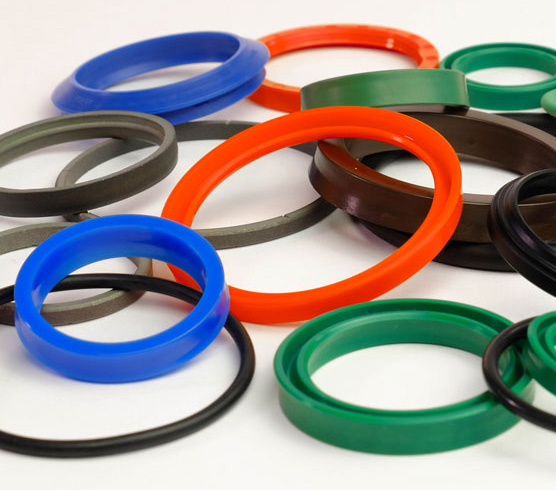
The seal in combination with the piston rod surface is decisive for the quality of a hydraulic cylinder and other fluid power products. Various, extremely different parameters come together here. "Sealing and minimising friction are actually opposing parameters," says Matthias Breisch, Head of Testing at Hänchen. "Therefore, it used to be 'either sealed or free-moving' in hydraulics." Sealing is a matter of course in quality products today. However, friction, wear, positioning and repeatability, maximum and minimum speed, stick-slip behaviour, minimum and maximum pressure, suitability for certain fluids, including Skydrol® or water-based fluids, and limit values for fluid contamination are other important parameters. In addition, there are the different sealing systems: Classic seals with sealing and wiper rings and non-contact seals with hydrostatically mounted piston rod guide or with the floating gap seal, by the way a patent of Hänchen. With classic seals, different sealing materials play a role as well as the geometry - especially that of the sealing edge. However, the condition of the counterface, for example the piston rod, as well as the friction and lubrication properties of different media are also decisive. These include chrome-plated steel or light metals, but also modern materials with special synthetic coating such as H-CFRP®, Hänchen's composite material made of carbon. The surface machining processes such as honeing or grinding of these materials also affect the sealing effect.

Seal testing process

Data acquisition and evaluation – measuring, controlling, regulating

The special Hänchen software controls the test process and test sequence as well as the evaluation of the measured variables. Thanks to the individual programming on Beckhoff systems, the user can control the test axes individually and run different motion profiles. For the measurements and the high-precision control, the test actuators are equipped with force transducers and position transducers. The friction force of the sealing systems is determined on the test stand, depending on the online measured parameters: Pressure in the test chamber, temperature in the test chamber and on the piston rod, as well as the position or the motion profile, for example speed. In order to achieve the most uniform results possible, the seals to be tested can be cooled. For particularly sensitive tests, the rod can also be cooled by means of a hollow-drilled rod. The data is recorded by the Ratio-Drive® software on an industrial PC, so that precise documentation and optimum test evaluation is possible. The user has the option of evaluating the measured variables recorded in the test stand either with the integrated evaluation tools or viewing them with any evaluation software such as Diadem.
 
Manual devices are used to measure the tightness of the primary seal and the entire sealing system to the outside. The running patterns on the rods and the inspection of the individual elements of the sealing system with regard to wear are also part of the evaluation.

Mechanical implementation – multiple test stand
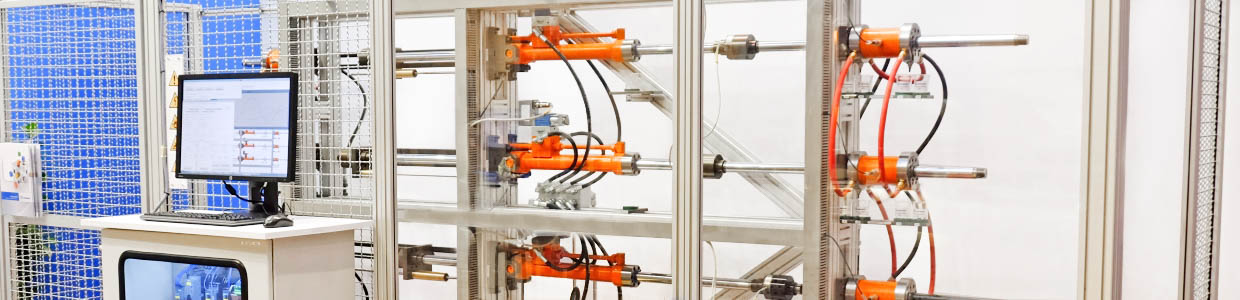
The plant, which was presented to the public at the end of 2015, has now completed its testing phase. The core element consists of four hydraulically operated test axles, each testing two test chambers with defined seal combinations. All four axles can be operated with different test specimen types and parameters. The stroke of the plant can be freely selected according to the rod. Speeds of up to 4 m/s are possible. In the self-sufficient parallel operation of all 4 rods, speeds of up to 1 m/s can be achieved, and the frequency can be up to 5 Hz.
 
Tests according to VDMA 24577 for determining the friction force are also possible on the seal test stand. The pressure in the test chamber can be up to 600 bar and is adjustable during movement, so that realistic conditions can be simulated. The movement profile is designed for sinusoidal or constant speeds. The acceleration phase can also be parameterised. Any rods with any seal combinations can be installed as test specimens and tested with a wide variety of fluids.
Seal test stand - Hänchen test stand construction

Test stand construction version

Standard test sequence for sealing systems

The test cycle commonly used internally by Hänchen for a sealing system consisting of a rod and seal combination normally comprises a mileage of 300 km in 24-hour operation. The extensive tests of recent years have confirmed the importance of PTFE seals with bronze filling as the primary seal in combination with a secondary seal and a wiper ring. The combination of compact seal, lip seal and wiper, which has proven itself as the Servocop® sealing system, implements this concept in hydraulic cylinders from Hänchen. "When compiling such combinations, it turned out that products from different manufacturers delivered very different results despite the same materials." Matthias Breisch describes a particular result: "The cross-manufacturer compilation of the elements delivers test results that differ by up to 50%. This does not mean that a seal is better or worse on its own, but that the coordination of the sealing elements with each other and with the counterface is decisive."
 
The importance of honeing as a fine machining process for rod surfaces for low friction in conjunction with very good distribution of the lubricants could also be confirmed. It was shown that short-stroke honeing further optimises the surface, while ground surfaces have a rather unfavourable effect on the performance and service life of seals. A correspondingly high-performance surface can also be produced on the material H-CFRP® by honeing.

Individual seal test stand

Hänchen Pfrüfstandsbau realises comparable test machines for customers such as the University of Stuttgart and has many years of experience as a manufacturer of drive systems. Within the framework of a Ratio-Drive® project, there is the possibility of manufacturing seal test stands specifically according to customer requirements. Modular construction and the use of the already proven software save costs and minimise prototype risks. The customer receives all mechanical components from a single source, from the drive to the integrated position and pressure measuring systems and the assembly. Together with the customer, Hänchen creates the safety concept of the Ratio-Drive® scope in accordance with the requirements of the Machinery Directive 2006/42/EC. This includes the requirements for machine controls according to ISO EN 12100 and in particular the assessment of the risk posed by the machine according to ISO EN 13849-1, depending on the requirement up to Performance Level PLe.
 
In-house application from concept to complete test machine and daily use give the various customer groups security.
Jörg Beyer, mediaword
© Hänchen 2017

Why Hänchen as a manufacturer for servohydraulic test machines?

Benefit from many years of experience with test stand technology

Many years of internal product development, research and development of test stands, test fields and complex test machines laid the foundation for modern Hänchen test stand construction. Our well-known high quality standards for all Hänchen products gave this development a massive boost. Today, Hänchen has developed into a reliable partner for individual test stands and test machines. Each EoL test stand is custom-made to customer specifications. Hänchen test stands are individually developed custom machines with a consistent concept. With every test stand project, you as the customer have a central contact person. This allows individual and energy-efficient test fields and complex test machines to be seamlessly integrated into your own systems through customer-defined interfaces.

Our competence as a manufacturer of test stands and test machines

  • More than half a century of hydraulic and seal competence
  • Extensive experience in special machine construction of hydraulic and electrical special machines
  • Experience in the systematised, individual design and realisation of customer projects
  • Measurement, control and regulation technology, real-time control, measured value acquisition, sensor technology, fieldbus connection and evaluation
  • Development of proprietary modular software, including graphical interface for control and regulation as well as communication at process level
  • Comprehensive safety concepts up to PLe in accordance with the Machinery Directive, CE conformity, safety software
  • Countless projects in the field of test stand construction and the development of complex test machines
Menu
DE