

Clamping head for hydraulic presses, injection moulding machines, ...
Clamping unit with DGUV Test certification
Clamping heads are used worldwide in machines as a safety component for personal protection.
With the approval of the DGUV Test, the clamping head is approved for use in hydraulic presses - according to EN ISO 16092-1/-3 and for synthetic injection moulding machines - according to EN ISO 20430.
Both of our designs, safety catcher and locking unit Ratio-Clamp®, are suitable for applications where lifted loads need to be secured against falling or unintentional lowering/sinking .
- Activated in the event of a power failure
- Acceptance of the DGUV Test
- No damage to the clamping unit
- No damage to the clamped rod
Use as a safety component
Securing gravity-loaded axles
If hazards due to external forces or loads according to EN ISO 13849-1 must be taken into account, the clamping head is a reliable technological solution. In the event of fluctuation or loss of pressure energy, the clamping unit locks round rods that are axially loaded.
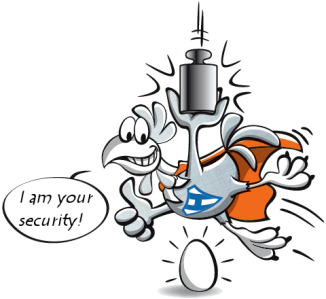
The clamping head is used as a safety element as follows:
- As a safe position holding element in the event of pipe rupture
- As a locking element when cylinders or valves have internal leakage, e.g. via throttle gap seals
- As a safety component in gravity-loaded axles, when hazards occur due to load, e.g. in lifting devices where there is a risk of dangerous lowering/sinking of a load.
The clamping unit is permissible as a safety component in accordance with EN ISO 13849-2. For a performance level that requires redundancy, it can be combined with a non-return valve as a secondary safety element, for example.
Functional principle of both clamping head versions
Personal protection for presses and injection moulding machines
Functional principle of the Ratio-Clamp®
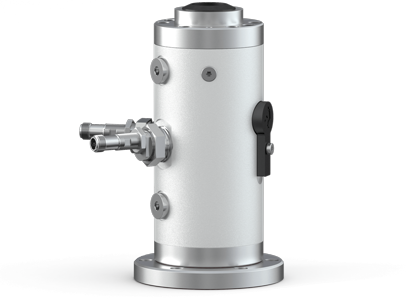
The Ratio-Clamp® locking unit can be used horizontally or vertically. It secures round rods direction-independently via frictional contact, in which a spring triggers the clamping mechanism in the event of energy failure. The clamp is opened via hydraulic pressure directly at the same point, without the rod retracting.
Functional principle of the safety catcher
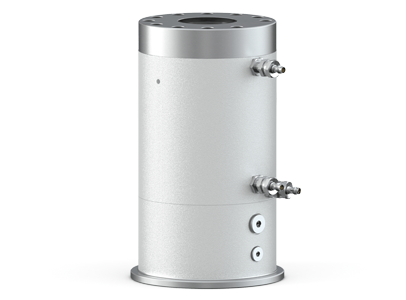
The safety catcher can be used vertically. It locks according to a self-reinforcing principle and can be loaded either in tension or compression, depending on the direction. The clamping is released via hydraulic or pneumatic pressure by retracting the rod.
Technical data of the locking unit Ratio-Clamp®
Horizontal and vertical installation
| RATIO-CLAMP® AS A SAFETY COMPONENT |
||||||
| + Releasing pressure + Locking + Sealing system + Certification |
Basic design With spring force Servocop® DGUV Test |
|||||
| Rod-Ø (mm) |
Permissible load (kN) |
Releasing pressure min. (bar) |
Installation |
Installation-Ø (mm) |
||
| 18 | 6,25 | 55 | 175 | 80 | ||
| 20 | 7 | 55 | 175 | 80 | ||
| 22 | 8,5 | 70 | 175 | 80 | ||
| 25 | 10 | 70 | 175 | 80 | ||
| 28 | 15,75 | 90 | 185 | 95 | ||
| 30 | 20 | 105 | 185 | 95 | ||
| 32 | 20 | 60 | 205 | 116 | ||
| 36 | 22,5 | 75 | 205 | 116 | ||
| 40 | 25 | 80 | 205 | 116 | ||
| 45 | 32,5 | 70 | 225 | 140 | ||
| 50 | 40 | 90 | 225 | 140 | ||
| 56 | 45 | 75 | 250 | 168 | ||
| 60 | 50 | 75 | 250 | 168 | ||
| 63 | 50 | 85 | 250 | 168 | ||
| 70 | 70 | 80 | 292 | 200 | ||
| 80 | 90 | 90 | 292 | 200 | ||
| 90 | 100 | 65 | 450 | 253,5 | ||
| 100 | 125 | 75 | 450 | 253,5 | ||
| 110 | 150 | 65 | 525 | 324 | ||
| 120 | 165 | 70 | 525 | 324 | ||
| 125 | 175 | 75 | 525 | 324 | ||
| 140 | 225 | 65 | 540 | 390 | ||
*The specified values apply to operation with mineral oil. When using other fluids such as HFC, the holding load may differ.
The holding forces of the locking unit Ratio-Clamp® correspond to at least twice the weight of the load to be secured.
In this Ratio-Clamp® variant with DGUV Test certification, the locked state is monitored and indicated by an inductive proximity switch. To monitor its function, this has an additional diagnostic output.
- Loadable regardless of direction
- Hydraulically released: min. see table, max. 160 bar
- Design key version up to Ø 100
- Factory check of the Ratio-Clamp® required after 1 million switching cycles
- Max. rod speed: 1 m/s with Servocop®
- Working temperature: -30 °C to +80 °C
- Fluids: Mineral oils or HFC*, others such as water or Skydrol® on request

Technical data of the safety catcher
Installation with tensile load or compressive load
| SAFETY CATCHER AS A SAFETY COMPONENT |
|||||
| + Locking + Certification |
Self-reinforcing DGUV Test |
||||
| Rod-Ø (mm) |
Permissible Load (kN) |
Installation length (mm) |
Mounting Ø |
||
| 25 | 10 | 152 | 71 | ||
| 28 | 15 | 169 | 82 | ||
| 30 | 20 | 180 | 85 | ||
| 40 | 33 | 211 | 106 | ||
| 50 | 52 | 264 | 125 | ||
| 56 | 67 | 262 | 140 | ||
| 60 | 90 | 262 | 150 | ||
| 63 | 100 | 285 | 160 | ||
| 70 | 107 | 302 | 172 | ||
| 80 | 133 | 322 | 194 | ||
The values given apply to all fluids.
Dimensions written in blue: stock sizes
The holding load of the safety catcher for machines has a safety factor of at least 2, but does not exceed a safety factor of 2.8.
- Compressive load or tensile load
- Hydraulically released: min. 40 bar, max. 250 bar
- Pneumatically released: min. 4 bar, max. 10 bar
- Factory check of the safety catcher required after 2 million switching cycles
- Max. rod speed: 0.5 m/s
- Working temperature: 0 °C to +60 °C
- Fluids: mineral oils, HFC or compressed air, others on request
FAQ on the clamping head
DGUV Test Certification
What is a clamping head?
A clamping head is a component that serves as a safety element in machines. It fixates round rods in any position by automatically activating the clamping mechanism when energy fails. Due to this functional principle, clamping heads are frequently used to secure loads, especially to avoid hazards in the event of a power failure.
How do you secure gravity-loaded axles in accordance with DGUV or the Machinery Directive?
Gravity-loaded axles, for example, must be protected according to EN ISO 13849. Depending on the Performance Level (PLr) to be achieved, redundant protection is required. In the case of hydraulic axles, this can be achieved via a lock valve in combination with a clamping head or locking unit or safety catcher.
Is the clamping unit a safety component according to EN ISO 13849?
The clamping unit can be used as a safety component in accordance with EN ISO 13849. On request, we will provide a B10D value for this purpose, which you can use to calculate your required MTTF value and determine the Performance Level.