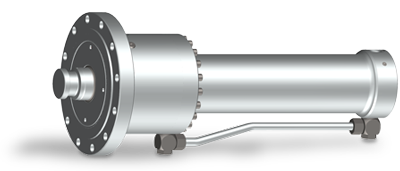
This distinguishes our custom hydraulic cylinders:
  • Decades of know-how
  • On-site consultation service
  • High quality of the components
  • Customer-specific solution
  • Honed sliding surfaces
  • Lifelong spare parts service

Individual designs for custom cylinders
Screw-in cylinders

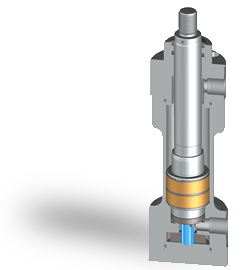
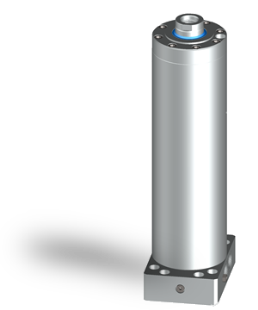
Hydraulic cylinders are mechanically attached and then hydraulically connected with hoses or pipes. A space-saving alternative are screw-in cylinders, which are installed in stepped bores with a stepped cylinder housing. This cylinder, which can be used in a block, is usually integrated into a machine and protected from external influences. The advantages:
  • Small installation volume
  • Simple installation without screwed fittings
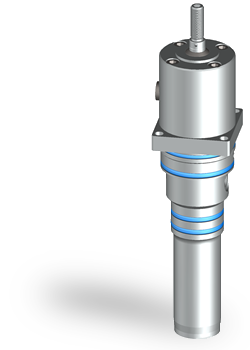
Screw-in cylinder

Individual designs for custom cylinder
Hydraulic cylinder with anti-torsion mechanism

Piston rods in hydraulic cylinders are usually protected against torsion by means of mounting components. If the rod is not fixed, it can twist. Even small external torques can be sufficient; even the surface structure of the piston rod can cause a torsion over the stroke. This can be avoided by mechanical devices, even for very high torques. We select the appropriate variant for your application.
Cylinders with anti-torsion mechanism

Individual designs for custom cylinder
Hydraulic cylinder as guide pillar

The solution for the space-saving combination of linear movements and precise guiding: the externally hardened guide pillar with integrated hydraulic cylinder. Here, loads coupled to the piston rod can be precisely guided and moved without loading the cylinder with side loads.
Hydraulic cylinder as guide pillar

Individual hydraulic cylinder design
Custom hydraulic cylinders with pressure protection tube

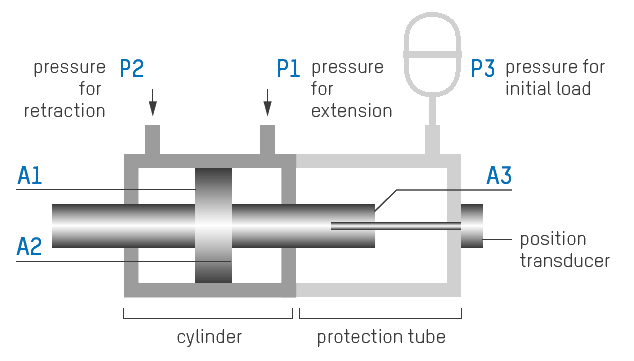
For weight compensation or to achieve a resilience, initial loads must sometimes be applied to test objects. For this purpose, hydraulic cylinders with a pressurised protection tube are suitable. Drive and hydraulic spring are thus combined in one component.

In this case, a double-rod cylinder is additionally pressurised on the free piston rod, the so-called protection tube side, with pressure from an accumulator. The working area A3, which results from the rod diameter, thus acts as a "protection tube spring". The hydraulic cylinder works with its two chambers A1 and A2 in addition to this constantly acting hydraulic force.
Hydraulic cylinder with pressure protection tube

Individual hydraulic cylinder design
Synchronous cylinders

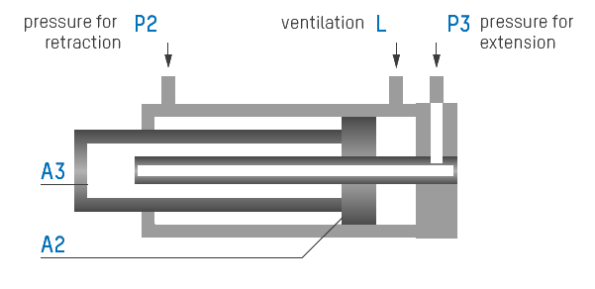
For dynamic movements, hydraulic cylinders with equal working areas are advantageous. The solution for little space or testing tasks with a long stroke is the synchronous cylinder. Its overall length corresponds to that of a cylinder with a single-ended piston rod. A large rod transmits the force to the outside, into which a smaller rod protrudes. This creates two working areas for extending A3 and retraction A2, which are the same size.
Synchronous cylinder

Rapid traverse cylinder with power stroke
Press cylinder, hydraulic cylinder with rapid traverse function

If a very high force is only required over a short stroke range when starting the hydraulic cylinder, rapid traverse cylinders with power stroke are used. For the remaining stroke of these hydraulic cylinders with rapid traverse function, a higher speed is available, but with a smaller working area and thus a smaller force. 
Rapid traverse cylinder in retraction direction

Extensions and adaptations for customised cylinders
Changing the fluid

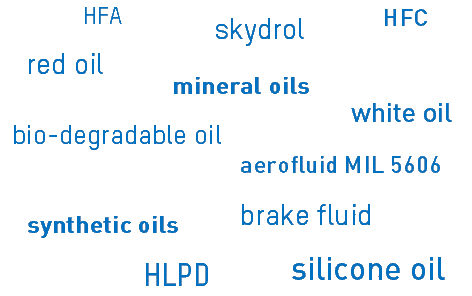
Depending on the area of application, different fluids are required. In the food industry, oils that are harmless to health are required, and in the steel mill, fire-resistant fluids. The customised cylinders are designed accordingly with suitable seals and coatings. Examples of fluids:
  • Mineral oils
  • Silicone oils
  • Biologically rapidly degradable oils
  • Brake fluid
Fluid

Expansions and adaptations for customised cylinders
Changing the material

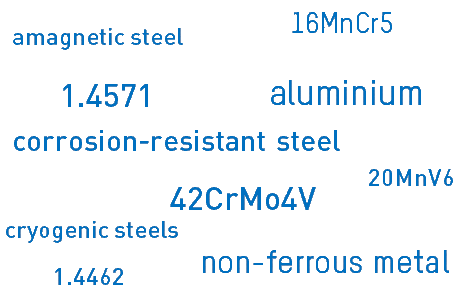
The choice of material depends on the application and is customised to your individual requirements. For example:
  • Stainless steel for the food industry
  • Non-magnetic steel for the medical industry
  • Aluminum saves weight
  • Cold-tough steel for use in cold regions/areas
Materials
Menu
DE